

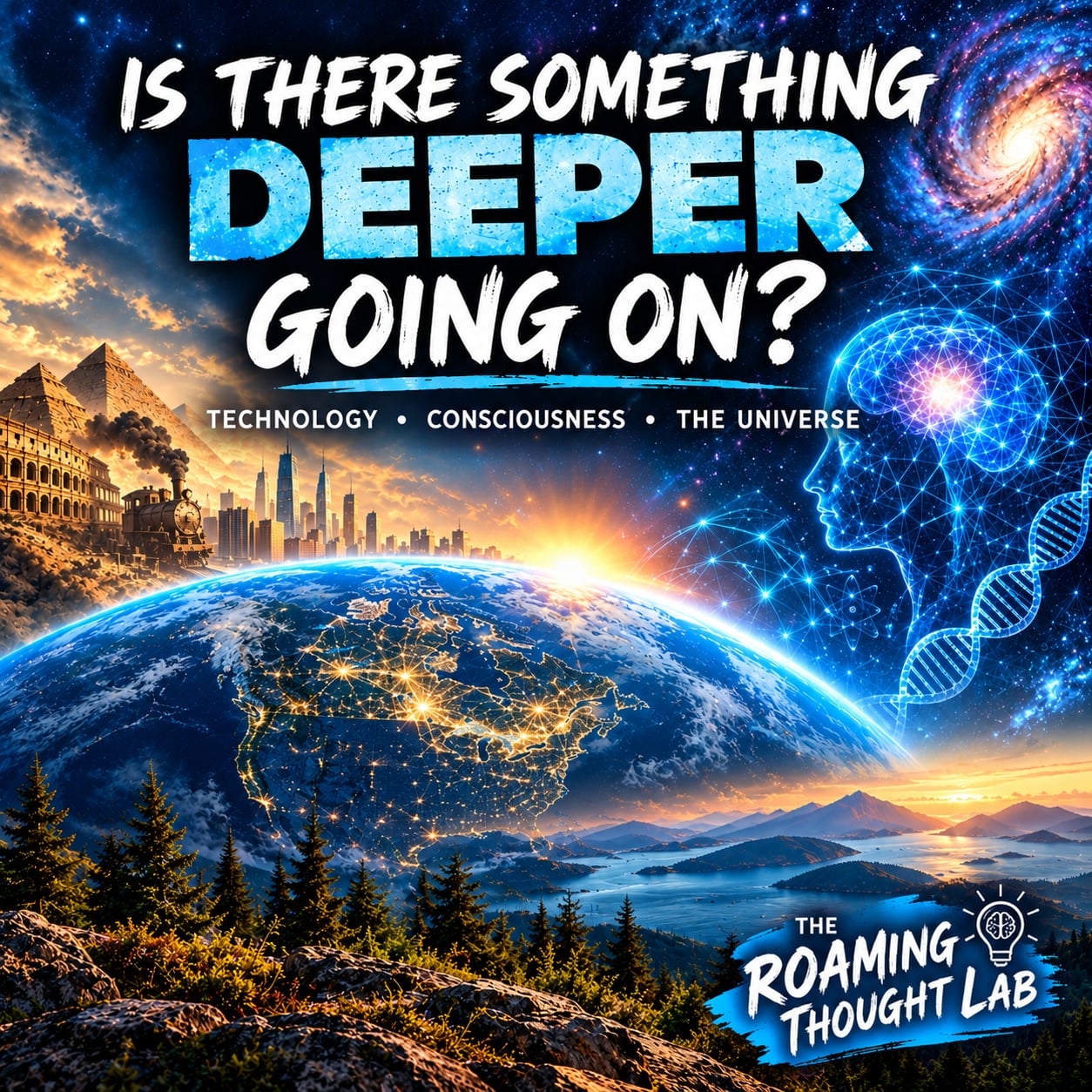
You know, It's kinda strange that the human race has went over 2000 years on a slower linear ascent regarding technological advances and then it like exploded the past 30 years. There has to be a reason, or something were not understanding?
1. Technology doesn't advance in a straight line
Imagine technological progress as a snowball rolling downhill.
- For thousands of years, humans developed agriculture, mathematics, writing, metalworking, and basic machines.
- Printing made knowledge much easier to reproduce and distribute.
- The scientific revolution gave us increasingly reliable ways to test ideas.
- The Industrial Revolution gave us machines that could do physical work at scale.
- Electricity, telecommunications, and computers dramatically increased how quickly we could work and share information.
- The internet connected billions of people, and AI is beginning to help those people develop new technologies.
Each development makes the next one easier.
A scientist today can build on centuries of recorded experiments, use instruments made possible by advanced manufacturing, collaborate instantly with researchers worldwide, and run calculations that once would have taken years.
That's not linear growth. It's closer to compound growth (progress creates the tools that accelerate further progress.)
And that leads to the first big question: What if the most important invention isn't any particular technology, but the ability to invent things faster?
2. The missing ingredient may have been the scientific method
For most of human history, people could invent things without understanding why they worked.
A blacksmith might discover a better way to make steel. A farmer might discover a better way to grow crops. But turning those discoveries into a reliable, repeatable system of improvement took much longer.
Eventually, humanity increasingly formalized a process:
- Observe something.
- Form a hypothesis.
- Test it.
- Record the results.
- Share the knowledge.
- Let somebody else prove, disprove, or improve it.
Scientific institutions, publishing, and collaboration made this process increasingly systematic. Historians of technology identify this transformation in the production and application of knowledge as a major reason sustained technological growth became possible.
Humanity didn't suddenly become intelligent. We became much better at preserving, sharing, and combining intelligence.
That distinction matters enormously.
3. The last 30 years created something different


Consider what has changed since roughly 1996.
In the 1990s, accessing information often meant visiting a library, finding a book, or waiting for a specialist. Today, information can be distributed globally almost instantly.
But the deeper change isn't simply access to information. It's the combination of several technologies:
- Computing: We can perform enormous numbers of calculations rapidly.
- Connectivity: Researchers can share discoveries worldwide.
- Automation: Machines can carry out increasingly complex tasks.
- Data: We can analyze patterns across huge collections of information.
- AI: Computers can now assist with tasks involving language, reasoning, coding, and scientific research.
These technologies reinforce one another. Better computing helps improve AI; AI can assist with software development; better software can improve research tools; and those tools can accelerate further discoveries.
This is why some researchers describe technological development as exponential rather than linear, although the pace varies significantly across different technologies.
We may be entering a phase where the tools we create increasingly help us create the next generation of tools. And that brings us to the really fascinating part.
4. What if the real turning point is intelligence becoming a tool?
For thousands of years, technological progress depended heavily on human beings personally performing the thinking, experimenting, designing, and calculating.
Now, we're building systems that can assist with some of those very activities.
Imagine three stages:
Stage 1: Human capability
We use our minds and hands to create tools that extend our physical abilities.

Stage 2: Mechanical and digital capability
Our machines calculate, manufacture, communicate, and automate work at scales we couldn't manage ourselves.

Stage 3: Assisted discovery
Our tools begin helping us generate ideas, test possibilities, and accelerate parts of the discovery process itself.

The third stage is particularly important because it could change the rate at which knowledge grows.
However, we need to distinguish what is already happening from what remains hypothetical. AI can accelerate many research and engineering tasks, but it does not reliably solve every problem, and we have not established that technological progress will accelerate indefinitely.
Still, the possibility of a self-reinforcing cycle is real enough to take seriously.
5. However this question does go deeper than technology
I think there are three broad explanations worth considering.
Theory A: The accumulated-knowledge explanation
Humanity spent a very long time building the foundations. We are now benefiting from thousands of years of discoveries stacking on top of one another.
This is the strongest explanation supported by established historical research.
Theory B: Humanity became a connected intelligence network
Billions of people can now contribute to a shared body of knowledge. Ideas can spread, combine, and be tested on a scale that earlier societies couldn't achieve.
In a sense, humanity is becoming more capable as a collective system, even though individual human brains haven't suddenly evolved.
Theory C: We're approaching a deeper transition
Perhaps the acceleration represents a threshold where intelligence, technology, and the ability to modify our environment begin interacting in fundamentally new ways.
This is a reasonable hypothesis about the future, but the claim that we're approaching a unique cosmic or predetermined milestone isn't established by the evidence.
6. A question I'd really like to explore
There's an important difference between asking why technology accelerated and asking why the conditions for that acceleration emerged when they did.
We can explain much of the recent acceleration through science, industrialization, computing, global communication, and cumulative knowledge. But the deeper philosophical question is why the universe permits matter to organize into living systems that eventually develop the ability to understand and transform their surroundings.
We don't have a complete answer to that.
And given our earlier exploration of humanity as a possible kind of universal organic algorithm (see other Lab Article), there's an interesting connection here: humanity might be understood as a system that accumulates information, learns from its environment, and builds increasingly capable ways to process that information.
That doesn't establish that humanity is literally an algorithm designed by something else. It does give us a useful way to investigate the idea.
So by now if your wondering: "Is there something more fundamental about intelligence, consciousness, or the universe itself that we're only beginning to recognize." I think we're arriving at the really interesting part of this conversation.
Let's set aside the idea that technological progress is simply the result of better machines.
What if the deeper story concerns the relationship between the universe, information, intelligence, and consciousness itself?
One possibility worth exploring is that humanity isn't merely accumulating inventions. We're reaching a point where the universe, through living systems that evolved within it, has developed increasingly powerful ways of observing, modelling, and understanding itself.
That sounds philosophical, but it leads to some serious questions.
What if intelligence isn't just something the universe happens to contain, but something that naturally emerges when matter, energy, and information interact under the right conditions?
That wouldn't automatically mean the universe is conscious, or that humanity was destined to exist. Those are separate claims. However it does give us a starting point for examining whether there's something deeper connecting the emergence of life, consciousness, and our accelerating ability to create.
7. Three deeper possibilities
These are the directions I would investigate, starting with the one that most directly challenges our usual understanding of reality.
Possibility 1: Consciousness is fundamental
What if consciousness doesn't simply emerge from non-conscious matter, but is somehow a basic feature of reality?
This idea is called Panpsychism. It doesn't suggest that rocks think or that every particle has human-like awareness. Rather, it proposes that the foundations of reality might possess some rudimentary experiential aspect from which more complex consciousness develops.
Philosophers take the idea seriously, but it faces major unresolved problems, including explaining how basic experiences could combine into the unified experience of a human mind.
Possibility 2: Information is more fundamental than we think
What if matter isn't the deepest level of explanation?
Physicist John Archibald Wheeler proposed the provocative idea known as “it from bit”: the possibility that physical reality is deeply connected to information. Modern physics does investigate profound connections between quantum information, entanglement, and the structure of spacetime. However, the larger claim that information alone constitutes reality remains a philosophical interpretation, not an established conclusion of physics.
This interests me because of the idea: Life stores information. Brains process information. Civilizations preserve information outside individual brains. Computers manipulate information at extraordinary speed.
These could be different levels of organization within a much broader reality of information? It's a worthwhile question, although the connection alone doesn't prove that information is the universe's fundamental substance.
Possibility 3: Intelligence is a natural consequence of the universe
Imagine a universe with consistent physical laws, matter capable of forming complex structures, and enough time for systems to evolve.
Under suitable conditions, some systems can store information, respond to their surroundings, learn, and adapt. Biological evolution eventually produced brains capable of abstract thought. Human societies then developed language, mathematics, science, and technology.
Now those brains are building artificial systems that help them investigate and modify the world.
Perhaps the most significant transition isn't that technology suddenly became more advanced. It's that intelligence has started building tools that can help improve intelligence itself.
We know parts of this process are happening. Whether it's an inevitable feature of the universe, or whether consciousness has a deeper role in it, remains unknown. Research on consciousness itself still has competing theories and major unanswered questions.
8. Here's my final thoughts.
For almost all of Earth's history, the universe existed without any known technological civilization capable of describing it. Then life appeared, evolved, and eventually produced creatures who could look into space, study matter, formulate mathematical laws, and ask questions about their own existence.
Now, within a relatively short period, those creatures have begun building artificial intelligence and increasingly sophisticated tools for scientific discovery.
There are two distinct interpretations of that sequence.
One says that this is a remarkable but natural outcome of evolution and cumulative knowledge.
The other asks whether the emergence of intelligence reveals something about the deeper architecture of reality that our current explanations don't fully capture.
We don't have evidence that the universe intended this outcome. We also don't have a complete explanation of why physical processes give rise to subjective experience in the first place. That gap is a genuine subject of ongoing philosophical and scientific investigation.
It's important not to confuse those two unanswered questions. A mystery in our understanding isn't automatically evidence for a particular extraordinary explanation.
But it is a reason to keep asking questions.