

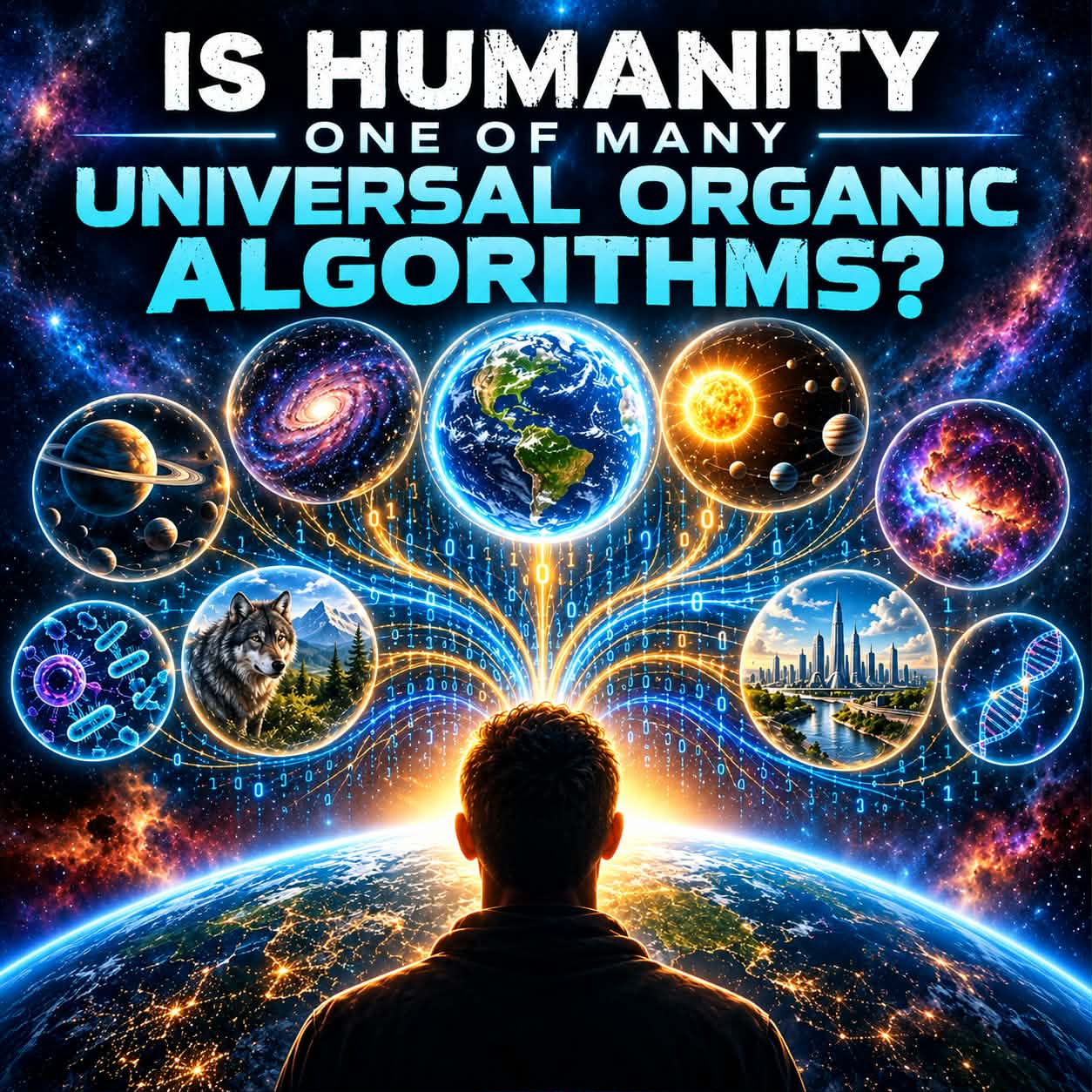
If we treat “algorithm” broadly, not as computer code, but as a repeatable process that takes inputs, transforms them, and produces outputs, then this idea gets surprisingly deep so it deserved to get a spot in The Roaming Thought Lab.
Let's work through it shall we, rather than immediately deciding whether it's too weird to be true.
First we start with the premise
Suppose the Universe contains many self-organizing algorithms.
Not necessarily algorithms "written by someone". More like how we view physics:
Given certain conditions, this is what happens.
Gravity could be viewed as an algorithm.
Evolution certainly behaves algorithmically:
variation → selection → replication → adaptation → repeat
Chemistry has its own rules.
Stars have their own processes.
Galaxies form according to underlying rules.
And eventually, one of these processes produces something capable of thinking about the process itself.
That would be us.
So what would the "human algorithm" look like?
Maybe something like:
Environment → survival pressure → cooperation → competition → language → knowledge → technology → civilization → increasingly complex civilization
And then the really interesting part:
civilization → creates intelligence capable of creating new intelligence (babies)
That's where the algorithm becomes recursive.
Humanity isn't merely running an algorithm.
Humanity starts writing new algorithms that modify the environment in which humanity itself operates.
Agriculture changed the selection pressures.
Cities changed them again.
Medicine changed them.
Computers changed them.
AI may be another enormous step in the recursion.
So perhaps humanity is something like:
A biological process that evolved the ability to deliberately modify its own evolutionary trajectory.
That's a pretty damn strange thing when you step back from it.
And now the idea gets even stranger
What if we're not the only one?
Imagine the Universe as containing countless different "algorithms" that emerge under different conditions.
Some produce stars.
Some produce planets.
Some produce biological life.
Some produce intelligence.
Some produce civilizations.
Some perhaps produce entirely different kinds of intelligence that we wouldn't recognize as life at all.
They don't necessarily have to be aliens flying around in spaceships.
They could be completely different solutions to the same fundamental problem:
How does matter organize itself into increasingly complex structures?
And humanity could simply be one particular solution.
Here's the part I find fascinating:
An algorithm doesn't necessarily have a goal.
Evolution doesn't have to "want" humans.
A river doesn't have to "want" the ocean.
A star doesn't have to "want" to become a supernova.
The process simply follows its rules.
That raises a disturbing possibility.
What if humanity doesn't have an ultimate purpose?
Not because we're meaningless.
But because purpose is something the algorithm itself eventually generates.
We evolved consciousness.
Consciousness asks:
"Why am I here?"
And the Universe may essentially answer:
"There was never a question in the first place."
😂
Now there's another question continuing this spiral down the rabbit hole.
If humanity is an algorithm, what happens when the algorithm becomes aware of itself?
Because that's arguably what we're doing right now.
A human being is thinking:
"What if humanity is a Universal Algorithm?"
Which means the system is examining its own behavior.
That's analogous to a program being able to inspect and modify its own code.
And that gives us a fascinating possible progression:
Matter → complexity → life → intelligence → self-awareness → technological intelligence → self-modification
If that pattern is real, humanity might not be the end product.
We might be a transitional stage.
And that connects rather neatly to the stuff I've written about before regarding AI, humanity, and whether intelligence eventually becomes something very different from biological humanity.
Maybe the important question isn't:
"What is humanity?"
Maybe it's:
"What process produced humanity, and what does that process tend to produce next?"
Because if humanity really is one of many Universal Algorithms...
we might be less like the finished program and more like one of the Universe's experiments that has just become aware that it's running.